
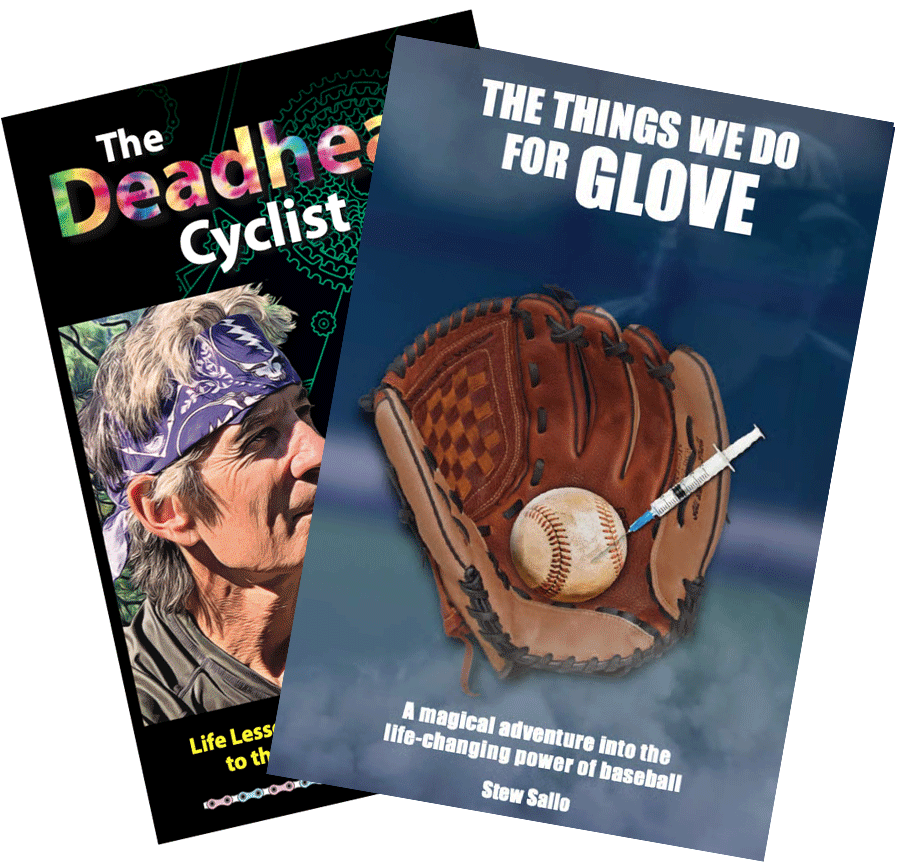
Reserve your copy of the latest addition to the library of baseball literature.
by Stew Sallo, author of “The Deadhead Cyclist.”
Life lessons on two wheels to the tunes of the
Grateful Dead
Robert Hall Weir, né Parber,
October 16, 1947 – January 10, 2026
Let the words be yours, I’m done with mine.
I first saw Bob Weir on October 19, 1974 with the Grateful Dead at Winterland Ballroom in San Francisco. I last saw Bob Weir on June 14, 2024 as a member of Dead & Company at The Sphere in Las Vegas. Over the course of almost 50 years, it was my privilege to see Bobby perform countless times as a member of the Grateful Dead, Kingfish, Ratdog, the Other Ones, The Dead, Furthur, Dead & Company, the Weir Robinson & Greene Acoustic Trio, and probably others that I have failed to remember.
Other Posts
This Week in Grateful Dead History: Week 25 - June 17, 1975
We just ride
It was a “slam dunk” picking T.W.I.G.D.H. for the week of June 15, since one of the most special nights in the band’s history took place on June 17, 1975 at Winterland. The show was billed as the Bob Fried Memorial Boogie, and it was one of only four times the Dead performed during the year of their interminable hiatus. Bob Fried was an artist who had died of a stroke earlier that same year, but not until he had designed dozens of signature ’60s and ’70s rock posters – most with a decidedly psychedelic spirit.
This Week in Grateful Dead History: Week 1 – December 31, 1978
The storyteller makes no choice
The Grateful Dead were famous for their New Year’s shows, and played twenty-one times at the stroke of midnight on December 31, at six different venues, all in the Bay Area. Six of those shows took place at the Winterland Ballroom, an erstwhile ice skating rink which became a storied rock music venue with a capacity of some 5000. Sadly, Winterland was shuttered in 1979, but not until one final concert had taken place. For reasons ranging from its eight-hour length, to the line-up that included the Blues Brothers and the New Riders of the Purple Sage, to the almost-six-hour DVD – The Closing of Winterland – that was made to commemorate the event, this was easily the most famous of the Dead’s New Year’s shows, and the Deadhead Cyclist’s choice for T.W.I.G.D.H., as well as the best New Year’s Eve show of all time.
All I Know
The year was 1970, my junior year of high school at Loara High School in Anaheim, California. It was the day of the All Western Band Review, the biggest, most significant high school marching band competition in the state. We had been working towards this moment for months, since the summer when band practice began a full three weeks before the first day of school.
All Material Copyright 2020, 2021, 2022 and 2023 by Stewart Sallo