
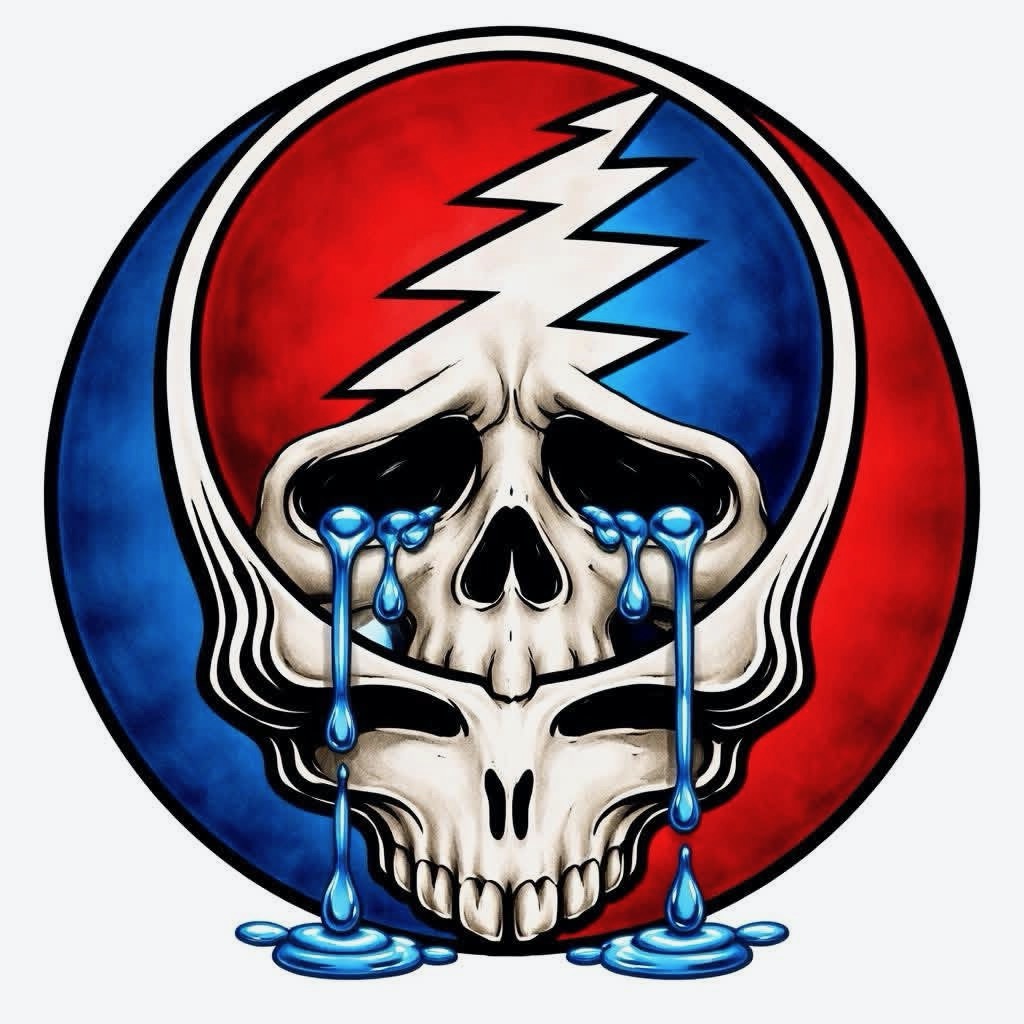
Robert Hall Weir, né Parber, October 16, 1947 – January 10, 2026
Let the words be yours, I’m done with mine.
By The Deadhead Cyclist
Published
12
January 2026
I first saw Bob Weir on October 19, 1974 with the Grateful Dead at Winterland Ballroom in San Francisco. I last saw Bob Weir on June 14, 2024 as a member of Dead & Company at The Sphere in Las Vegas. Over the course of almost 50 years, it was my privilege to see Bobby perform countless times as a member of the Grateful Dead, Kingfish, Ratdog, the Other Ones, The Dead, Furthur, Dead & Company, the Weir Robinson & Greene Acoustic Trio, and probably others that I have failed to remember.
As a longtime fan of the Grateful Dead, and most recently in my role as the Deadhead Cyclist, I have spent countless hours listening to literally thousands of recordings of Bobby, and have come to a deep appreciation of his singular approach to the art of the rhythm guitar and his often powerful vocals. It is often speculated that he might be the most recorded guitarist of all time, and may have taken the stage as a performer more times than any musician in history.
But these credentials – as impressive as they are with respect to the quality and quantity of notes, chords and songs he played and sang as a musician – pale by comparison to the role Bob Weir played in his influence upon American culture over the course of a lifetime that appeared to end suddenly, belying a seemingly indestructible persona.
Only once or twice in a lifetime does something compelling enough in its capacity to capture the human experience arrive, and the Grateful Dead is precisely that. The evidence is found in the way multiple generations have been touched by the “Pied Piper” quality of the music, and the indisputable rightness of the message that has emanated from this most unique American band and its countless offspring. Over the course of the last 60 years, the Grateful Dead has been nothing less than a cultural icon, embraced by millions as an antidote for the wrongness of so much of what we contend with as part of the uniquely American human experience.
Most importantly, the Grateful Dead is a vision of America that is desperately needed, as the original American Dream has become corrupted, threatened by greed and lust for power. In this music and the community that surrounds it, we find a handle to grab onto that restores our hope that better days lie ahead, and that the darker side of human nature can be vanquished by the “love in the dream” that lies in wait. Put another way: “Something new is waiting to be born.”
When Jerry left us on August 9, 1995, conventional wisdom was virtually unanimous: There could be no Grateful Dead without Jerry Garcia. However, what Bobby recognized was that there were two aspects to the Grateful Dead: the band known as the Grateful Dead, and the cultural movement by the same name.
The late Jerry Garcia started this movement, but Bob Weir did something perhaps even more significant: He kept it going. For 30 more years! Think about that for a minute in this context: When Jerry left us on August 9, 1995, conventional wisdom was virtually unanimous: There could be no Grateful Dead without Jerry Garcia. However, what Bobby recognized was that there were two aspects to the Grateful Dead: the band known as the Grateful Dead, and the cultural movement by the same name.
After allowing some time to pass, Bobby formed a new band, the Other Ones, including former members of the Grateful Dead, along with other first-rate musicians, in an effort to keep the Grateful Dead movement going, while honoring the end of the Grateful Dead band in the wake of Jerry’s death. To be sure, this was not an easy task. The Other Ones and each of their successors, culminating in the ten-year run of Dead & Company, were the subjects of relentless criticism, mostly in the spirit of those shortsighted enough to limit their focus to the fact that the endless parade of lead guitarists in these bands – Steve Kimock, Jimmy Herring, Warren Haynes, John Kadlicek and, of course, John Mayer – were all guilty of one irrefutable failing: they weren’t Jerry.
But Bob Weir was on a mission. No longer Jerry Garcia’s self described foil, he answered the call in spite of the critics, not merely to keep the music going, but more importantly to keep the message alive long enough to inspire multiple generations, thereby ensuring what will prove to be unprecedented longevity – for both the music and the movement.
Having attended some 25 Dead & Company shows over the course of the last 10 years – often with my daughters, my niece, and other members of the younger generations – it became abundantly clear that the Grateful Dead movement had transcended generations, and that the message of hope, common spirit, community, and the affirmative celebration of life had been “Built to Last.”
Looking at the many faces, it was evident that the “kids” dancing and shaking their bones were in their 80s, 70s, 60s, 50s, 40s, 30s, 20s, and even younger. Thanks to Bob Weir, the Grateful Dead’s music, movement and community will continue to live on, perhaps for 100, 200, even 300 years or more.
As sad as Bobby’s passing is for so many, it signals us as his survivors to take the baton that has been handed to us and carry it boldly and faithfully in the direction of our personal and collective destinies, inspired by the commitment and dedication he showed to bringing forth the best in human nature. Clearly now “we are on our own.”
Thank you, Bobby! Rest in peace. We got this now.
Want to find out about future concerts of the week?